

Goodbye, 2025
Midnight hits different at 51 and medically retired—so here’s what 2025 taught me about loss, progress, and finding purpose in a life I didn’t plan.


Tonight, 2026 will start for me the same way 2025 did: me in front of my TV, watching an elevator climb to the top of one of the great symbols in one of the great American cities.
There’s just something about fireworks and lasers bursting off the saucer-shaped icon of Seattle. The Space Needle is one of those landmarks most Americans can name if you show them a picture. It’s ours. And it still hits me every time.
As someone who’s 51 and disabled, midnight-and-later isn’t exactly “normal” anymore.
Sometimes I don’t feel old… and then I stay up until 1:00 a.m. on New Year’s Eve. New Year’s Day arrives and I’m not in the mood I want to be in. The weird part is, no matter what time I go to bed, my body refuses to sleep past 8:00 a.m. Doesn’t matter if my head hits the pillow at 10:30 or 1:30—my internal alarm clock is ruthless.
I know plenty of West Coasters my age who talk about doing “East Coast New Year’s,” meaning when the ball drops live at 9:00 p.m. Pacific, it’s goodnight and see you tomorrow. I’m not there yet… but I might be if I lived Central Time somewhere like Illinois or Iowa.
But that got me thinking: if we do “NYC New Year’s” from the Left Coast, what do people in the real Big Apple do if they want to celebrate the new year and not stay up until the witching hour? Do they celebrate Atlantic Time? Or do they tie one on when Big Ben strikes midnight in jolly ol’ England (that’s 7:00 p.m. in the city that never sleeps)?
Who decided January 1st gets to be the start?
And who determined January 1 as the first day of the year, anyway, with the Gregorian calendar? Maybe the Chinese—with their animal years—have it right.
New Year’s is often treated like this single global moment: a ball drop in Times Square, fireworks over Sydney, countdown clocks synced to midnight on January 1. But the reality is a lot more interesting. The “start” of the year is a story different cultures have been telling in their own ways, on their own calendars, for thousands of years.
Across the world, communities mark the turning of the year using solar, lunar, and lunisolar systems—systems that rarely line up neatly with the Gregorian calendar’s January 1.
In East Asia, Lunar New Year arrives between late January and mid-February, tied to the cycles of the moon rather than a fixed date. In Iran and across much of Central and South Asia, Nowruz is anchored to the spring equinox—a celebration of renewal literally built around the return of light and warmth. In Southeast Asia, water-throwing festivals like Songkran in Thailand mark New Year in April, when the hottest season turns and daily life resets.
Religious calendars add another layer of “New Years” on top of civil life. The Jewish calendar begins again with Rosh Hashanah in the early fall, tying spiritual reflection and communal accountability to the agricultural cycle. The Islamic calendar, which is purely lunar, marks its New Year with 1 Muharram, moving about 11 days earlier each Gregorian year. In Ethiopia, Enkutatash arrives in September, close to the end of the rainy season, carrying its own seasonal and spiritual transition.
So if you don’t like how your new year is going… wait long enough and another one will show up. You can just start over.
Settling into the life I have
I’ve had plenty of those years. Thankfully, 2025 wasn’t one of them.
This year was about settling into my life on my couch—looking at my vestibular migraines and PPPD as what my life is. It looks like it’s here to stay, and no matter what is done, my life from here out will be shaped by focusing on what I can do—not on everything I’ve lost (which is a lot).
I’ve spent enough time in mourning. It was time to move forward.
And the truth is, progress for me usually looks like two steps forward and then one step back… and sometimes more than one. But 2025 was a year of self-exploration—testing what I’ve still got in me, and starting to find purpose again.
How can I help people who are disabled like me? Because when it becomes you, the world tilts.
I don’t walk through an airport anymore—I get pushed by an employee. Taking my shoes off and going through TSA isn’t routine anymore. Now everyone has to move as you’re escorted through, and people get startled out of their daydreams while they’re just trying to clear the next hurdle on the way to the friendly skies. Then someone asks you to move over so another person can cut in front of you—even if that person also looks disabled.
Meanwhile, I’m trying not to get sick from everything going on around me all of the time, and the airport is loud in a way that people like me feel in our bones. I used to love flying. Every part of it.
Now it’s a necessary evil—something I have to endure to get to my destination… and then recover from the brutal challenge that is travel in my current state.
The other war: weight
The new year of 2025 also meant me fighting another battle with my body. This one has to do with my weight.
It’s a battle I’ve won many times… but I still haven’t won the war.
In world history, there have been wars named after how long they lasted: the Hundred Years’ War, the Eighty Years’ War, the Seven-Day War.
My war is more like the Thirty Years’ War: the war between me and my body.
Ever since my early 20s, it’s been constant. And for a long time, my body was on offense while I was in denial. Instead of standing up and fighting, I just retreated—buying larger sizes and refusing to see the actual person staring back at me. I was looking at who I thought I was, or who I wanted to be.
Over the years, I’d go on “lifestyle changes” (aka diets, if we’re being honest). I’d lose 50 pounds here, 70 pounds there… but no matter what I did, the war kept slipping away. And I wasn’t overeating—I just never felt full. So to win a battle, I’d basically starve myself.
I tried eating “normal” and exercising like crazy. I trained for two 5K runs and barely lost any weight… because I was still fighting it wrong.
And then January 20, 2022 happened—and my life changed forever.
I got sick with something that took six months to figure out. I spent 8 to 10 hours a day horizontal on the couch just trying to get through the day. Depression—another sneaky enemy—joined forces with my body and became an undeniable force.
In that state, I threw up the white flag.
When the dust finally settled and I took stock of what was left, I was almost 100 pounds heavier than I was before that fateful day.
That’s when I called for reinforcements.
I couldn’t battle this on my own anymore—or with “traditional techniques.” I dove into the deep end and went to a weight loss and bariatric clinic at the University of Washington.
There I met with a medical doctor who worked with me to build actual battle plans—how to fight this scourge and, hopefully, win the long and brutal war that leaves casualties behind.
We used strategies I’d never used before:
Mentally (therapy)
Strategically (nutritionist)
Medically (Zepbound—one of the GLP-1 meds you’ve definitely heard about)
In my current medical state, I’ve felt like I’m fighting with one hand tied behind my back. I can’t do much physical activity because of vestibular migraines and PPPD.
But as of the end of this year, I’ve lost more than 70 pounds.
The war isn’t won, but I’ve won some big battles—and the enemy is on its heels. 2026 will be a huge year: 365 days of opportunity to push closer to the ultimate goals.
I’m not busting out the “Mission Accomplished” T-shirts and hats too early.
The cruelest part: people
This is the first time I’ve been in this position before—on either side of the roller coaster. Either climbing or sliding.
I’ve received tremendous compliments when I’ve won battles. And I’ve received brutal, soul-crushing critiques from people I respected and considered friends.
It started with someone from my fraternity in college pulling me aside and telling me what I looked like—and what people were saying about me.
Later, it happened on Radio Row at a Super Bowl I was working. Someone I knew well. Someone I considered a friend… maybe even someone I looked up to. He hadn’t seen me in a while and he verbally assaulted me for what I had become, demanding to know what happened to me.
It was a sneak attack I wasn’t prepared for. It left me emotionally wounded that someone I considered a friend would talk to me like that—and choose to approach it that way.
It took me a long time to recover from that blow.
And honestly, I think I lost a friend that day, too.

The Lindsay family declares: Year of the Dog
Unlike Chinese New Year, the Gregorian New Year doesn’t name each year after an animal.
But if it did, the Lindsay family would like to submit 2025 as: The Year of the Dog.
After a year without one, there was a hole in my life—and my soul—that needed to be filled by a dog. I didn’t realize how much four-legged friends anchored me until we were a house without one. Some days got dark and lonely, especially the weeks when my wife was out of town on business.
Sophie is two years old now. She’s the princess of the household. It’s her house—we just live in it.
And she brought joy back into our space.
She’s been good for me physically and emotionally. Sophie pushes me to get up and play fetch even when I don’t feel well. She’s brought companionship to me and my wife in a way that’s hard to explain unless you’ve lived it.
Living with something people don’t understand
When something happens to you health-wise, there are certain conditions most people can relate to—or at least have a mental picture of: cancer, heart attacks, surgeries, strokes, the flu.
But with rarer conditions, the person living it is always stuck explaining.
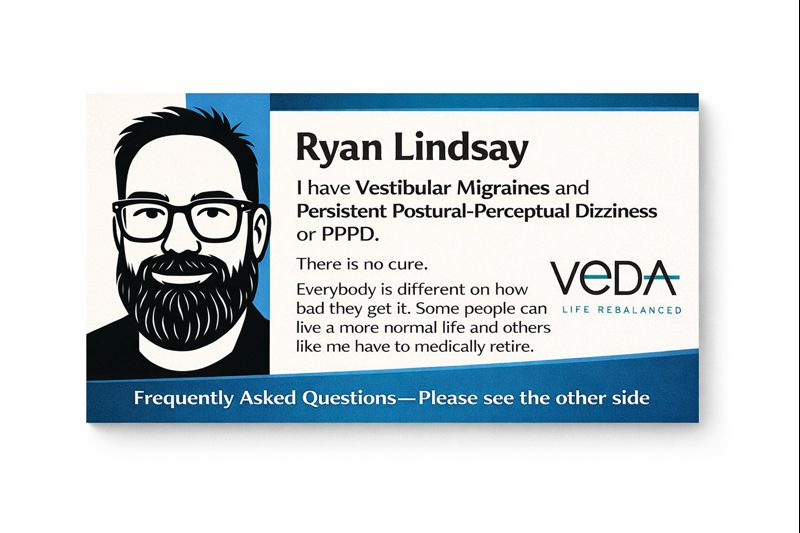
When you tell someone you’ve been diagnosed with vestibular migraines and Persistent Postural-Perceptual Dizziness, the first reaction is a blank look followed by: “What is that?”
Then come the blank stares and the open-ended questions.
Now that I have personal experience, I can tell you: it gets exhausting.
You almost want a sign—or a business card—you can hand people. And honestly, some people do that, especially when going through TSA or flying. That’s fine in those moments. But you don’t want to keep going to that well in every setting.
And when time passes and you don’t look “better,” the questions turn into: “Are you getting any better?”
That question brings tremendous pressure. What are you supposed to say to that?
Finding my people
That’s why finding a support group—people all over the world with similar symptoms and diagnoses—has been such a lifeline. No blank stares. No weirdness. No constant explaining.
Instead, you get people who actually understand. People who can answer questions you didn’t even know how to ask yet.
As my wife has said many times, there’s only so much she can relate to when it comes to what’s going on inside my body.
My support group is full of people like me—medically retired, trying to rebuild a life that doesn’t look like the one we planned.
When I started attending weekly meetings two and a half years ago, I didn’t know this would become my reality. I didn’t know working a job would be in the past and the future would be new, different, and extremely… whatever this is.
But those people helped me get through a lot. They became an extended family I’d see once a week.
And none of it would’ve been possible without the nonprofit that supports people like me: the Vestibular Disorders Association (VeDA). They’ve become part of my life now, too, as I volunteer to help raise money and awareness for this uncommon condition that can strike at any age.
Over time, I became especially close to the three people who organize and run our support group. They’ve become close friends and confidants.
So much so that we flew out to Chicago in September to meet two of them in person.
Have you ever walked up to someone you’ve never met face-to-face, but you feel connected to them like they’re family?
That’s exactly how it felt—the first time we hugged in person.
We’re there for each other in struggles and victories. Our texts and Google chats are going 24/7, 365 days a year. They’ve made me feel like I’m not alone—and I love them for that.
We’re already talking about a bigger and better meetup in 2026.
I would love that.
Goodbye, 2025
So goodbye, 2025. I took your good and your bad and made it to the other side.
We’ll see what 2026 brings. And it starts tomorrow.
I’m still working on a follow-up post on WSU athletics and more reaction to the Kirby Moore hire. I also have a really cool feature in the works with help from some legendary Seattle sports and media figures.
Subscribe so those posts go straight to your email.
Happy New Year from my couch.